
A Legal Primer for Digital Art
- Fiona DeGiacomo Buck
- Mar 9
- 6 min read

How do you protect the rights of intangible art and its creators within a legal system that was designed around the physical object? With the proliferation of AI images and videos that seek to expedite and effectively replace human artistic output, this question is more pressing now than ever. A few days ago on March 2nd, 2026, the Supreme Court denied writ of certiorari, or the right for a plaintiff to continue to appeal a decision, in the seminal Thaler v Perlmutter case from 2023. This decision ends the legal debate of whether Large Language Models can be allowed to copyright art that is purely generative and has no element of human creative input, with the court ruling that “human authorship is a bedrock requirement of copyright.” The upholding of this decision dictates that while AI can be used as a creative tool for assistance, the driving force behind the end product must be human. Without it, AI images will automatically enter into the public domain, or be able to be freely used, and subsequently not be protected from issues of infringement, exclusivity, or trademark.

The arduous task of defining digital art from a legal standpoint has been a subject of discourse in US and international courts for centuries, and the definitions are constantly evolving to fit the changing epoch and protect the rights of artists and patrons in the metaverse. Discussions of authenticity and fair use in fine art and cultural heritage in the United States date back to a canonical Supreme Court ruling in 1883. The Tutton v. Viti decision centered around a discussion of marble sculptures that had been copied from another artist and established a key precedent for the court deferring to creative rendering and craftsmanship when evaluating art for the purposes of taxation or protection. The court stated that there was no difference between the technical proficiency and skill needed to create an original or a copy. They ruled that “an artist’s copies of antique masterpieces are works of art of as high a grade as those executed by the same hand from original models of modern sculptors.” The Supreme Court further upheld congressional expansion of copyright being intrinsically linked to the skill of the artist in the 1884 Burrow-Giles Lithographic Co. v. Sarony case, where they extended Copyright protection to photographs.
Asserting that it is not the job of the court or the judge to be the arbitrator of culture or define a creative object, Justice Holmes noted that:
“It would be a dangerous undertaking for persons trained only in the law to constitute themselves final judges of the worth of pictorial illustrations, outside of the narrowest and most obvious limits. At the one extreme some works of genius would be sure to miss appreciation. Their very novelty would make them repulsive until the public had learned the new language in which their author spoke. It may be more than doubted, for instance, whether the etchings of Goya or the paintings of Manet would have been sure of protection when seen for the first time. At the other end, copyright would be denied to pictures which appealed to a public less educated than the judge.”
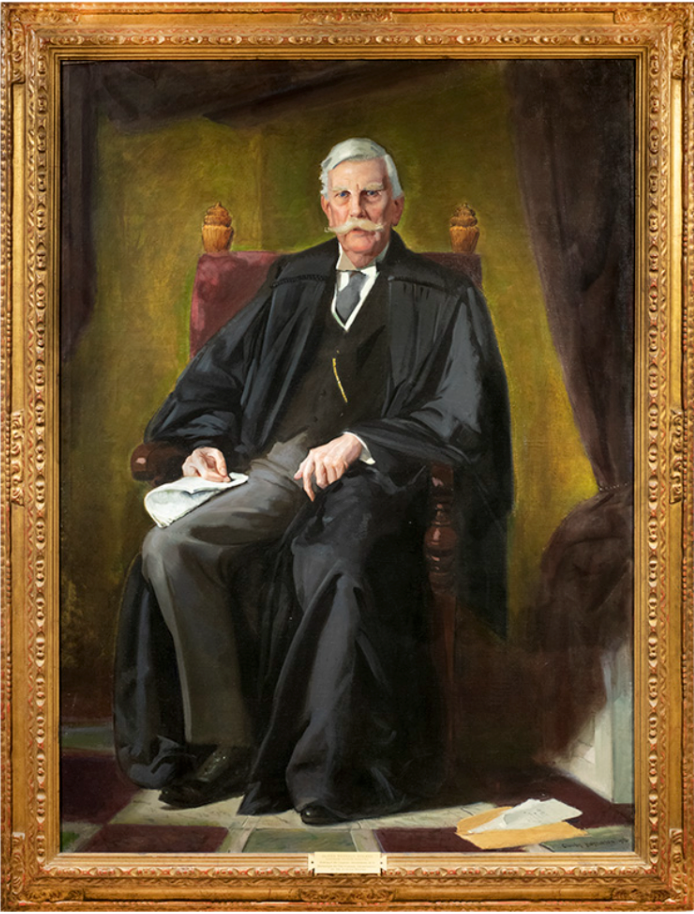
This seminal quote echoes the precedent set by Tutton v. Viti decision and continues to frame the art law narrative to this day. It is of paramount importance since it establishes that judges should not take on a role as arbiters of culture in the fine arts, but rather arbitrate solely on the basis of existing IP law.
Following this precedent, in January of 2024, Judge Sidney Stein issued a highly anticipated and consequential final judgment in two high-profile art market cases that centered around the same fair use defense. Fair use in the arts, under the United States legal system, protects work that has been significantly
creatively transformed, even if it appropriates a previous artist’s image protected by copyright. Graham v. Prince and McNatt v. Prince centered around the seminal conceptual and pop artist Richard Prince. The defendant, who is represented by Gagosian Gallery, is renowned for altering reproduced images and appropriated content from mass media to provide social commentary on the relationship between social media and art. However, artists Donald Graham and Eric McNatt respectively accused Prince of copyright infringement of their original photos. The argument for fair use was based upon the fact that “by adding the Instagram frame and interface along with likes and comments, as well as the intentional cropping of images and absurdly proportioned scale, Prince had transformed the image.” However, Judge Stein ruled that the creative modifications were not substantial enough to qualify the pieces as sufficiently transformative. Following legal negotiations between the plaintiffs and Prince, the artist agreed to privately settle and pay both Graham and McNatt, and the financial reparations exceeded the retail price of Prince’s pieces at Gagosian.

In the metaverse, the primary concern for many artists is protecting their intellectual property rights in order to ensure that they can claim full authorship of the work. Guaranteeing proper attribution for an artwork in the digital sphere is protected to some extent by the Visual Artists Rights Act of 1990. VARA, however, is limited in scope in that it only protects use for public display as opposed to use in advertising and publication, and not for personal artistic pursuit. The Lanham Act (Trademark Act) and the Copyright Act (Title 17) also provide finite protection for the work of living artists or images that are not yet in the public domain, but as sustainable legal practices continue to emerge, these documents will need to continue to be amended in order to accommodate rapidly changing digital practices.
While the NFT bubble has definitively burst from a market perspective, the craze of the early 2020s prompted much legal discourse around protections for both the people minting the NFTs and those acquiring them. While purchasing an NFT gives a patron sole rights to the ownership of the digital token on the blockchain, it does not necessarily give the new owner the rights to the copyright of the piece. Just like buying a physical painting or sculpture, the copyright attached to the image or object belongs to the artist unless otherwise contractually specified in the bill of sale. While the purchaser has acquired the right to exhibit and re-sell on a secondary market, it is illegal under US Title 17 and international copyright law for the owner of the digital asset to reproduce images of the NFT.

From a legal perspective, it is thus crucial to understand exactly what is included in the “smart contract” or the codified and unalterable digital certificate of authenticity which grants ownership of the NFT. In January of 2023, Congress requested a joint study be conducted by the United States Copyright Office and the United States Patent and Trademark office “regarding issues of intellectual property law and policy arising from the use of non-fungible tokens (NFTs).” The study recognized widespread concern that many NFT buyers, especially in the fine art sector, do not purchase tokens with a full understanding of what intellectual property rights are implicated in either the creation or transfer or ownership of NFTs. Furthermore, they found that NFTs are high risk assets when it comes to the facilitation of copyright and trademark infringement. They also discussed the contentious issue of whether NFTs are merely a form of title to a subset of rights in a digital asset or are themselves a separate digital asset.
The Copyright Office has long played a role in advising Congress on the effect of emerging technologies. In the 1960’s they considered whether copyright could vest in expressive works created with a computer. Even then, they concluded then that “the answer was, yes, it could, but only if human authorship was present.” From this decision to the March 2026 ruling about AI passed into case law by Thaler v Perlmutter, it has been made clear that legally, artistic production must be predominantly human in creative origin in order to be protected by safeguarding measures in court.
From the perspective of marketing and advertising, this will trigger a re-evaluation of mass media consumption. If major corporations can’t feed a photo of their product into AI and generate an aesthetic video with the click of a button, will they turn back to traditional methods? While branding for something instantly recognizable will remain under copyright protection, if logos are included in purely generative AI content, the end product will no longer be protected. Could this decision mark the beginning of a resurgence of jobs that had been widely considered at risk of loss in the face of AI? Only time will tell, but this ruling can be marked as a definitive win for both artists working with traditional methods, and those incorporating ethical use of Large Language Models.


