
Modernism in Dialogue: Stein, Picasso, and AI
- Fiona DéGiacomo Buck
- Jan 12
- 8 min read
Updated: Jan 13

Picture Paris at the turn of the century: the blur of streetlights streaming against the rain-stained window of a ricocheting cab— a cacophony of wafting jazz lingering amidst mingled languages and cigarette smoke—the sip of absinthe as it cuts through the fumes of mid-summer haze—the haphazard medley of cobblestone and concrete on Rue Mouffetard. Did Picasso and Stein have it right? Is modern life best described in fragments, that only when combined make sense as a whole? Think of the sound bytes of trending audio and inexhaustible images that characterize our digital lives. Why do some things, even those generated by AI, capture your attention and stop your finger from scrolling up? Do they resonate because they are grounded in memories of physical experiences, or because they capture simultaneous modes of perception? The answer, and why we are still so drawn to the work of the Parisian Avant-garde, is both.
Modernism demands that we question the conventions of language and image. It calls for us to break down the fundamental vocabulary of a medium and deconstruct meaning and form before returning them to a point of reassembled legibility. In both writing and painting, the modernist works of the early 1900’s embraced a prolonged and continuous present. Just as Picasso grew to reject the need to work purely representationally from the world around him and instead combined multiple perspectives through cubism, Stein rejected the underlying assumption that writing must be modeled off of the conventionally spoken English language. Her experimental prose forces us as readers to look critically at the words themselves without thinking of them as representations of objects, because she is less interested in symbolic meaning than in the medium of the language itself and the deconstruction of its formal properties.
Much like our contemporary split between tangible reality and that of the metaverse, the modernism of the Parisian Avant-garde demands that we are able to discern between the overlapping yet simultaneous modes of perceptions that take place within the urban metropolis. The forms taken by this work, as viewed through the lens of the words of Stein and brushstrokes of Picasso, ask one central question. In a zeitgeist characterized by AI, the answer feels more pertinent now than ever. Can human experience and perception be broken down into a base code, so as to be formally reproduced as a single image or consolidated into a single sentence?

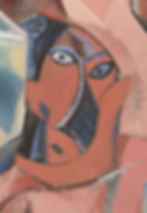
Similar to the reclamation of painting as more than just a conduit for realism, the subversion of normative grammar reclaimed the sentence as an active, generative form. Stein uses the sentence and its notation as the site of resistance against the conventions of literary language. Her repetition of clauses, extended syntax, and constricted vocabulary closely follows the fragmentation and dissolution of form within the visual plane achieved by a piece like Picasso’s 1907 Les Demoiselles D’Avignon. Within the bounds of his canvas, Picasso abandons the traditional rules of perspective in favor of a flat, two-dimensional picture plane. Similarly angular swathes of rose and red ochre define the bodies of each figure, favoring repetition over naturalistic description of individual characteristics.
The successful and never-ceasing experimentation within these two mediums was driven in large part by the fact that their creators existed in perpetual personal dialogue with one another. This was fostered by Gertrude and her brother Leo’s socio-intellectual salon at 27 Rue de Fleurus, the exhibition space at 21 Rue de la Boétie, run by seminal dealer Paul Rosenberg, and Picasso’s Montmartre studio space the Bateau L’avoir. These vibrant fulcrum points facilitated the forging of professional and personal relationships between those who make the art, those who sell it, and those who buy it. The market for modern art, as defined in the western canon, originated in Paris. The evolution towards creative autonomy placed the artist at the center of a promotional enterprise resulting in the joining of the artist’s studio with the dealer’s market and the galleries. The avant-garde was set against the backdrop of the Impressionists and Post-Impressionists and their ability to establish themselves outside the academy and official patronage. Subsequently, aspiring painters had to seek out their own sources of financial security and exposure in ways that had not been necessary for the previous generations of artists. However, this enabled a level of free creative dialogue to take place in a way that had previously been impeded by the conventions and barriers of socio-economic class.

The importance of this dialogue becomes especially clear when comparing their respective portraits of each other. In her writings, Stein muses about their initial encounter, cleverly perpetuating the myth of her own portrait. Completed in oil in 1906, the eponymous work renders her as monumental. Picasso depicts her as enduring and statuesque—an immovable sphynx whose obsidian gaze pierces out from behind the harsh contours of her mask-like face. Her features are tactile and sculptural, as if modeled out of clay, and their flat planes stand in stark contrast against the russet strokes lightly delineating the draped clothes, high-back chair, and patterned upholstery surrounding her. Her naturalistic body is grounded yet characteristically two dimensional. Picasso directly translates reality onto canvas in a way that captures much more than the physical qualities of a woman leaning forward for the painting of her portrait: it captures a kaleidoscope of moments in one still frame.
In a 1938 memoir simply titled Picasso, Stein recalls sitting for the piece, writing “I posed for him all that winter, eighty times and in the end he painted out the head, he told me that he could not look at me any more and left once more for Spain…” (12). This formal separation of head from body serves as one of the first visual markers of Picasso’s exploration into analytical cubism. To the contemporary viewer, it constituted a stark and jarring departure from the academic portraiture of the previous century. It embraced the characteristically modern trope of a prolonged and continuous present, whereby producing a likeness to reality is less important than capturing an enduring personality, and to this extent he rendered her in multiple perspectives. Stein continues in a later chapter, writing that “it was the first time since the blue period and immediately upon his return from Spain he painted in the head without having seen me again and he gave me the picture and I was and I still am satisfied with my portrait, for me, it is I, and it is the only reproduction of me which is always I, for me” (14). Although her sentences do not follow conventional grammatical rules, they retain their overall meaning, just as the figures in Picasso’s Demoiselles retain recognizable female form. Both are deconstructed and simplified, yet demand that the reader or viewer see purely what they are looking at, free from singular meaning or supporting context.

Mimicking Picasso’s increasingly abstract approach painting, by 1910 her writing had descended into the verbal equivalent of synthetic cubism, whereby form is not taken apart, but rather emerges out of deconstruction. A prime example of this methodology can be seen in Stein’s 1911 work, If I Told Him, A Completed Portrait of Picasso. Here, with regards to both content and language, her prose projects conventional sentence structure onto the visual realm of the canvas, mirroring, repeating, and deleting meaning where she sees fit before reassembling it.
From the repetition of individual words to the incomplete clauses and sporadic use of punctuation, she restricts her verbal palette in a way that calls explicit attention to the smallest nuance of tone and rhythm. Where Picasso forces background and background foreground to meld through manipulation of line, color, and planes of space, Stein forces words to repeat themselves, and compels fragmented clauses to come together to form an ultimate whole. Although she alludes at times to Picasso’s attributes, the formal structure of the piece verges on unintelligible.

In her 1914 Tender Buttons, Stein employs this methodology towards her descriptions of everyday objects—her still lives, if you will. She manipulates the tactile and visual qualities of actual things while rejecting a single point perspective. Stein utilizes a terse compression of parataxis, or the juxtaposition of clauses or phrases without the use of coordinating or subordinating conjunctions, as a device with which to hold disparate ideas in equilibrium.
Traditionally, this grammatical structure of “things piling up” results in a rush of ideas and a sinuous and insistent rhythm, much like how Hemmingway’s writing is characterized by a fast moving narrative. This stands in stark contrast to hypotaxis, the subordination of one clause to another, which Stein abandons completely in her later work and deconstructed prose. Critic Stanley Fish writes that the contrast between parataxis and hypotaxis is like “the difference between walking through a museum and stopping as long as you like at each picture, and being hurried along by a guide who wants you to see what you’re looking at as a stage in a developmental arc she is eager to trace for you.” However, for both Stein’s portrait of Picasso and his Demoiselles D'Avignon, we are thus allowed to pick and choose which fragments we are inclined to to linger on, try to decipher, or move past without a second thought. This freedom from hierarchy is one of the most revolutionary things to come out of the turn of the century in Paris, and the Modern Art movement as a whole.

If we are to now answer our underlying base question about Modernism, the answer is unequivocally yes. Through text and image, both of these seminal creators succeeded in capturing the essence of consciousness: evolution, experimentation, and change. Through combining multiple perspectives into one work of art, cubism allows us to perceive infinitely more than just what we are looking at. Through making us think about words as more than just symbols arranged on a page to convey sentient meaning, Stein forces us to question what language is. Their work teaches us that human experience and perception can be broken down and codified in a way that translates the nuances of pain, love, beauty, and brokenness— but only through human artistic production.
Think now for a moment about our contemporary progression of AI. A mere 6 months ago the prompts fed into an algorithm resulted in an abstract and often unintelligible image. However, new Large Language Models are capable of a level of photorealism that can be hard to distinguish from reality. To do this, AI pieces together fragments of different creators without any referential context to authorship. The code does not feel guilt at its appropriation; it does not experience wonder at the privilege of being exposed to a culture with a different perspective on aesthetics. Picasso revered the indigenous masks and sculptures that so deeply inspired his explorations. By contrast, AI deletes all traces of its sources the second a text to image prompt is finished rendering. At a base level, it comes down to one thing: the nuance of human consciousness simply cannot be replicated. While technology will inevitably reach a point where it can create facsimiles of artistic production, the importance of human connection, dialogue, and symbiotic evolutions of creative thought are what make art art. Without them, we lose access to the authentic spirit of innovation and collaboration that defines the New Renaissance we are entering; the same world that Picasso and Stein dared to exist within.
